
What Is a Moore County Court Docket
A docket is the running schedule and event list for a case. In Moore County, a docket may show the case number, party names, hearing date, time, courtroom, judicial officer, event type, attorney information, disposition status, and recent entries. It may also show that a case is pending, disposed, dismissed, appealed, or set for another hearing. Docket data gives a case timeline, but it does not always include the actual filed document.
North Carolina uses one statewide court system. Moore County does not have separate city or justice-of-the-peace courts. Superior Court handles felony crimes, civil cases of $25,000 or more, and some appeals from District Court. District Court handles misdemeanors, infractions, traffic, domestic, juvenile, small claims functions through magistrates, and lower-value civil matters. That division matters because a searcher may find different calendar types for criminal, civil, family, traffic, or estate-related proceedings.
A docket should be treated as a working calendar and activity record. Hearing dates can change after a continuance, conflict, service issue, attorney request, or court order. A summons, citation, attorney notice, or clerk instruction may have more current instructions than an older printed docket copy. When a court date is close, the safest check is the portal result plus the local schedule or a direct clerk confirmation.
The official Moore County local administrative schedules page is the county-specific calendar resource.
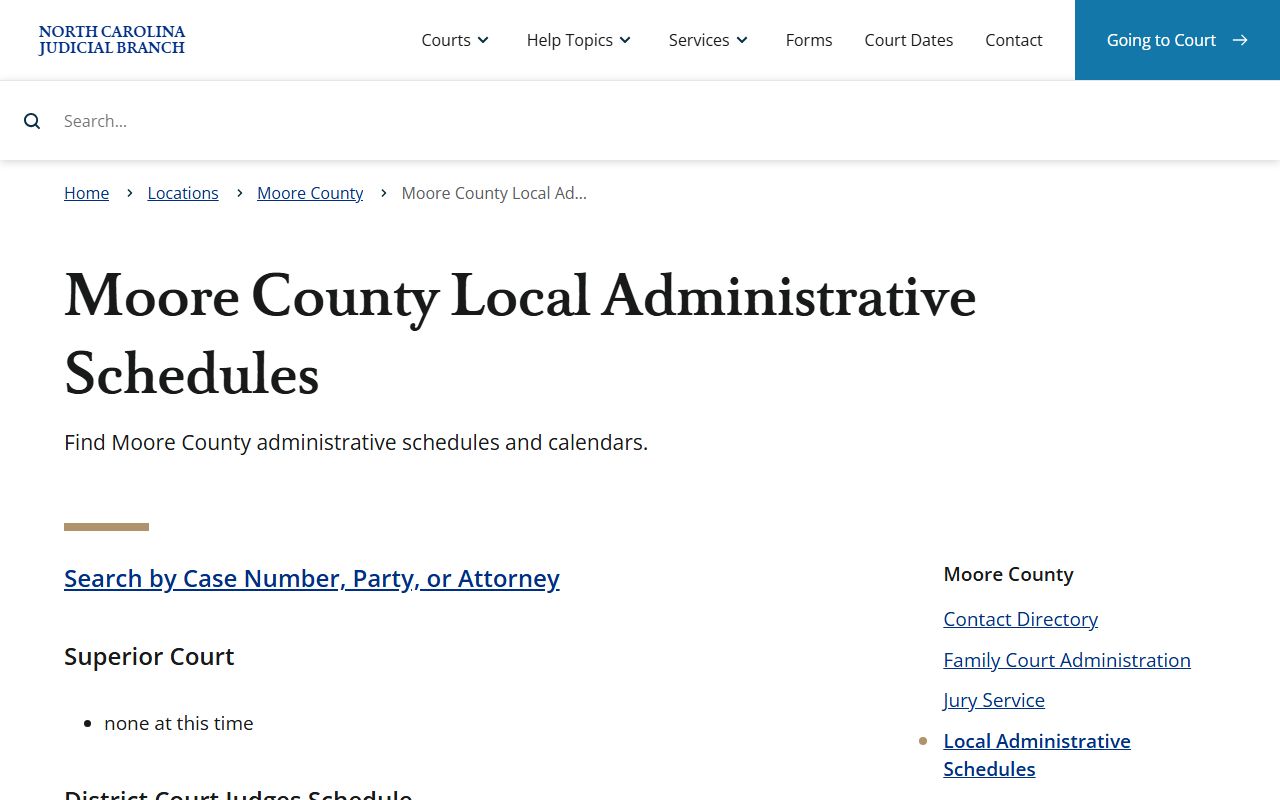
Those schedules are useful when a portal case result needs local calendar context or a session type needs confirmation.
How to Find Moore County Dockets Online
The online path begins in the NC eCourts Portal. Search Hearings is the docket-focused function. Official training states that hearing searches can use case number, party name, business name, attorney name, attorney bar number, judicial officer, courtroom, county, and date filters. Smart Search may also show docket entries and case history for a known case.
Search Hearings is useful when the question is where to appear and when. Smart Search is stronger when the question is what has happened in the case. NC Judgment Search is narrower and should be used when the issue is a judgment index. Payment status may be visible for eligible criminal or infraction cases, but a payment tile is not a complete docket history.
- Open the portal and select Search Hearings for court dates or Smart Search for case activity.
- Enter a case number, party name, business name, attorney, bar number, judicial officer, or courtroom.
- Use Moore County and a date range when filtering hearing results.
- Review the hearing time, courtroom, location, officer, case number, and event type.
- Call the Clerk of Superior Court if the result conflicts with a notice, summons, or attorney instruction.
The Moore County Family Court Administration page adds a local detail: callers should have the file number ready, with the example format 00-CVD-0123 shown on court papers.
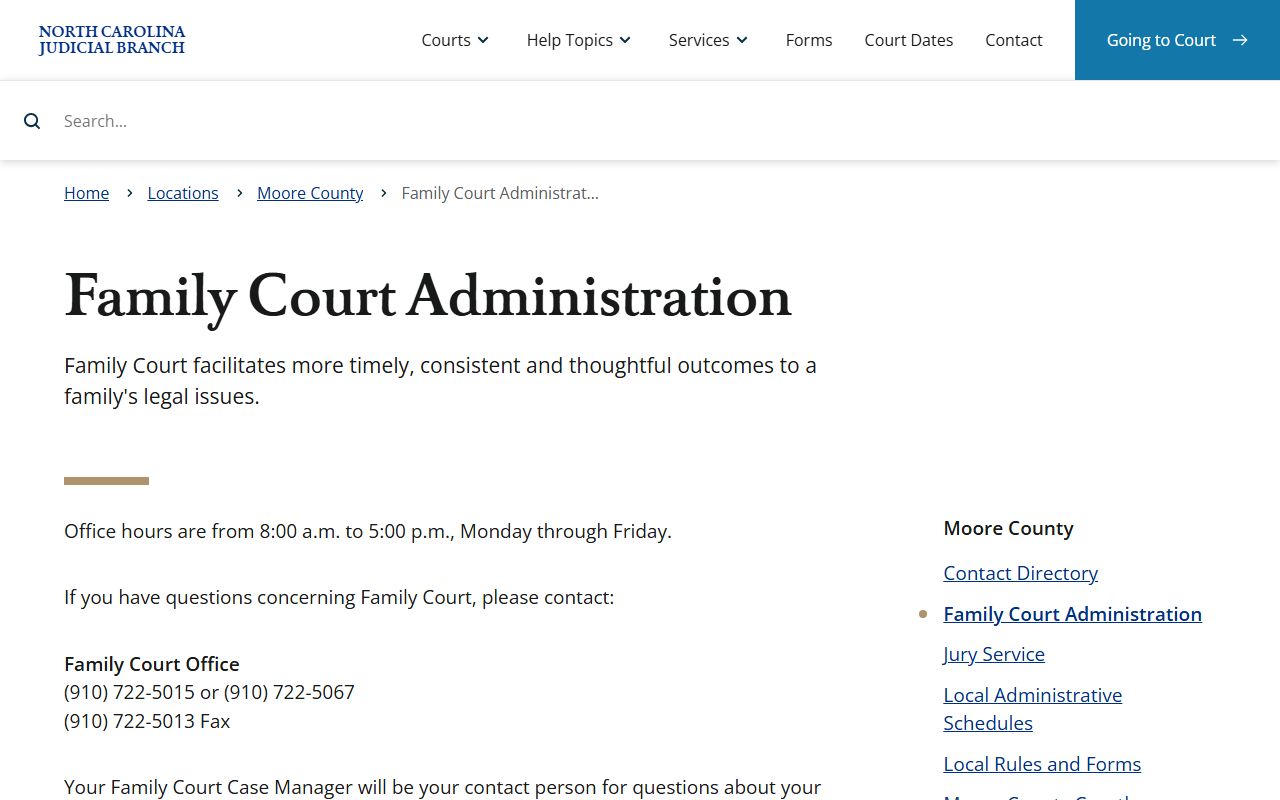
That file-number instruction is especially useful for custody, support, divorce, and other family-law docket questions.
Sample Moore County Docket Fields
The research did not capture a live sample case because the portal is dynamic and session based, but official training and local court pages identify the public fields a user should expect. Hearing results are a schedule view. Docket entries are a case-history view. Both should be read with the case type, court division, and date in mind.
Moore County docket fields often need to be read together. A party name without the county filter can produce similar names from other North Carolina counties. A judgment result may show disposition status and index information but not the complete case summary. A hearing result may identify the courtroom and judicial officer without showing every motion or order in the file. The clerk's paper file remains the record source for complete documents.
| Field | What It Shows |
|---|---|
| Case number | The unique case identifier used by the court and often needed for clerk or family court calls. |
| Party name | The person, business, estate, State, plaintiff, defendant, petitioner, or respondent tied to the event. |
| Hearing date and time | The scheduled court appearance or event time. |
| Courtroom and location | The courtroom, county, and hearing location when available. |
| Judicial officer | The judge or officer assigned to the event when listed. |
| Status or disposition | Whether a case or judgment is pending, disposed, dismissed, closed, or otherwise resolved. |
| Docket entry | A filing, order, continuance, hearing, judgment, dismissal, notice, or appeal event. |
The county's local rules and forms page can affect docket practice for family, civil, and other matters.
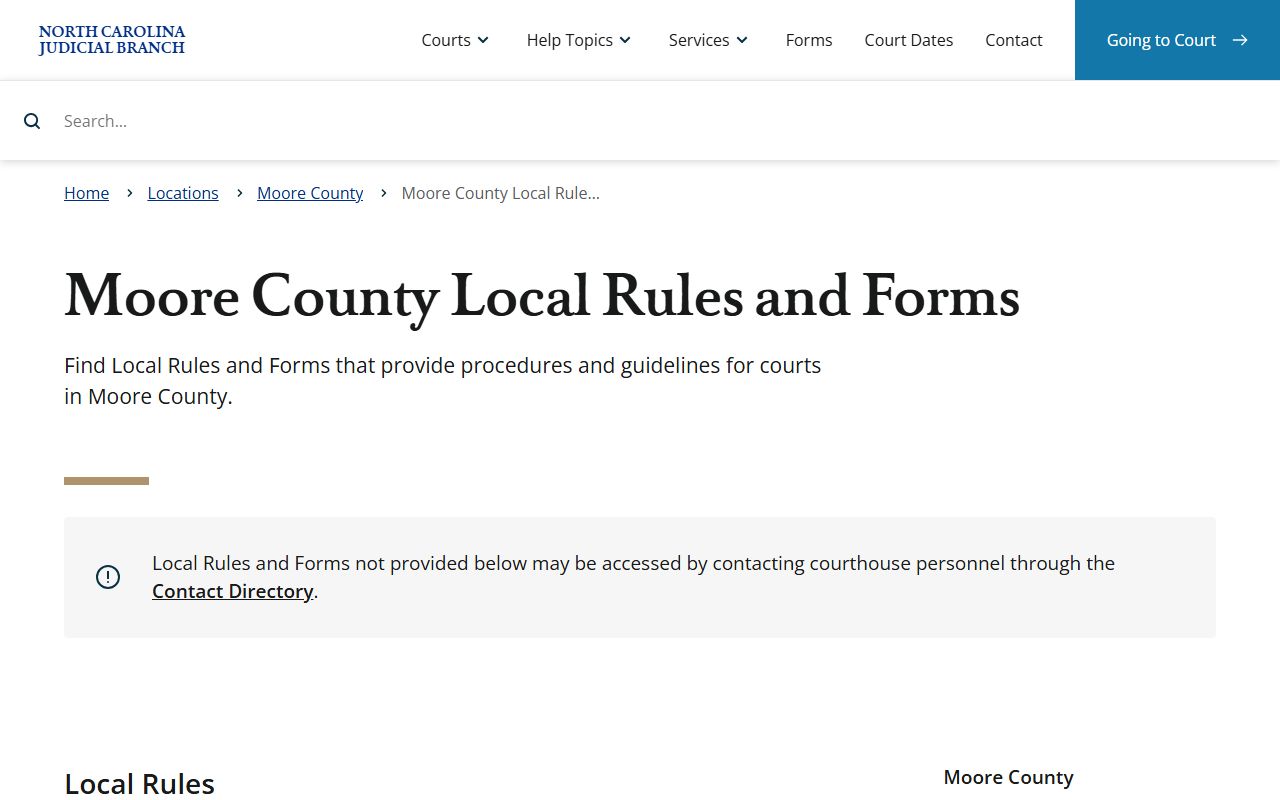
Local rules are not a case calendar by themselves, but they explain scheduling preferences, required forms, and case-management details.
Courts With Moore County Dockets
Moore County dockets are tied to the Superior Court Division, District Court Division, magistrate functions, and clerk-managed matters. The court contact directory lists Superior Court Judges, District Court Judges, Family Court, the District Attorney, Guardian ad Litem, Magistrates, and the Clerk of Superior Court. These are not separate local courts. They are points within the North Carolina court system serving the county from Carthage.
Some calendar questions belong outside the public docket result. Jurors follow summons instructions and the recorded-message process rather than a party case docket. Family case-management questions may go through Family Court when the caller has the file number. Prosecutor scheduling questions in criminal matters may involve District Attorney District 29, but public case records and certified copies still remain with the clerk.
- Superior Court: felony criminal matters, higher civil cases, and appeals from District Court where allowed.
- District Court: misdemeanors, infractions, traffic, domestic, juvenile, small claims appeals, and lower-value civil cases.
- Magistrates: initial appearances, warrants and criminal process, small claims functions, and some marriage ceremonies.
- Family Court Administration: case-management help for family matters and file-number questions.
- Clerk of Superior Court: filings, records, estates, judgments, terminals, copies, and docket access support.
Jury service is also docket related because trial calendars can affect reporting. The official Moore County jury service page gives the reporting location, parking notes, and summons call-in rule.
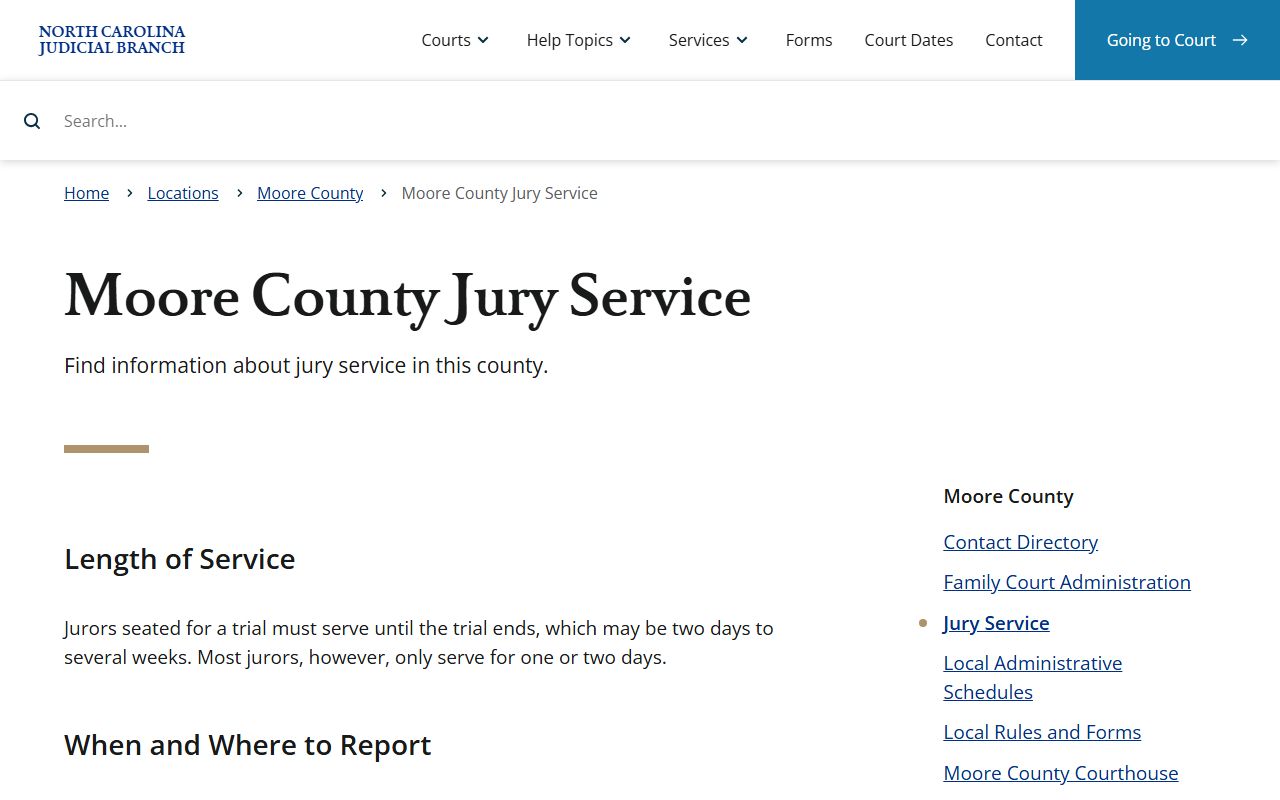
Jury instructions should be checked separately from a case docket because summons reporting can change by recorded message.
Moore County Dockets vs Case Records
A docket is a map of activity. A case record is the file behind that activity. A Moore County docket can tell a reader that a motion was filed, a hearing was scheduled, or a judgment was entered. The full case record may contain the motion, order, pleading, judgment, financial obligation, or other paper. Some documents may be viewable in the portal depending on access level, but complete paper files are still reviewed through the clerk in the county where the case is located.
| Docket | Full Case Record | |
|---|---|---|
| Purpose | Tracks dates, events, and case movement. | Stores pleadings, orders, judgments, and filed documents. |
| Common access | Portal hearing search, Smart Search, and local schedules. | Portal summaries, clerk terminal, paper file, and copy request. |
| Best use | Confirming a court date or case stage. | Reviewing legal content or requesting a certified copy. |
| Limitations | May not show the document text. | May require in-person review, fees, or restricted access. |
Note: A docket entry can show that a judgment exists, but certified judgment copies must come from the clerk.
How to Read Moore County Dockets
Start with the case number and court division. A family case number such as the example 00-CVD-0123 points to a civil district case format. A criminal or infraction docket should be checked for the charge, hearing date, courtroom, officer, disposition, bond or release condition if shown, and financial obligations if the case is payable. A civil docket should be checked for complaint, summons, answer, motion, order, mediation, judgment, dismissal, and appeal entries.
Common words need context. A disposition is the result of a case or charge. A continuance is a new date after a hearing is postponed. A motion is a request for the court to act. An order is the judge's directive. A judgment is the court's decision or sentence. An appeal moves review to a higher court or division when the law allows it.
For unresolved conflicts, use the official contact chain: portal result, local administrative schedule, notice or summons, attorney if represented, and then the Moore County Clerk of Superior Court at (910) 722-5000. Family case-management questions can also use the Family Court office numbers listed in the contact directory.
Moore County jurors have a separate local timing rule. The jury-service page tells jurors to call the number on the summons on the first day of summons between 12:00 and 1:00 p.m. and follow the recorded instructions. Excusal or deferral requests may be submitted online or by mail to the Chief District Court Judge through the Clerk of Superior Court, and requests must be received no later than 10 days before the summons date. Those jury instructions are schedule-related, but they are not a substitute for checking a party's case docket.
Traffic dockets have their own practical wrinkle. A citation may be waivable, payable online, payable in person, payable by mail, or require a court appearance. The court docket shows the court side of the citation, while the driver record is a separate DMV record. A missed traffic date or unpaid obligation should be checked with the clerk before assuming warrant or license consequences.