
Moore County Superior Court and District Court Overview
North Carolina has a unified statewide court system. The official court-structure material states that there are no local court systems in the state. Moore County cases move through the Superior Court Division, the District Court Division, magistrate functions within District Court, the Clerk of Superior Court, and statewide appellate courts when appeals are allowed. That structure is why the local trial court page should not be read as a list of numbered district courts.
Moore County is served from the Moore County Courthouse in Carthage. The official contact directory lists the Clerk of Superior Court at (910) 722-5000, Superior Court Judges at (910) 722-5016, District Court Judges at (910) 722-5012, Family Court at (910) 722-5015, District Attorney at (910) 722-5010, Guardian ad Litem at (910) 722-5110, and Magistrates at (910) 722-5019. The courthouse also houses public terminals and physical court-file access for local cases.
The trial-court structure also explains record routing. A felony case, a higher civil case, and an appeal from District Court point toward Superior Court. A misdemeanor, traffic infraction, domestic case, juvenile matter, small claims appeal, or lower-value civil action points toward District Court. Estate administration is handled by the clerk's office under its probate role. The record custodian for these local court files remains the Clerk of Superior Court.
The statewide North Carolina divorce packet is one example of District Court forms that affect Moore County domestic case filings.
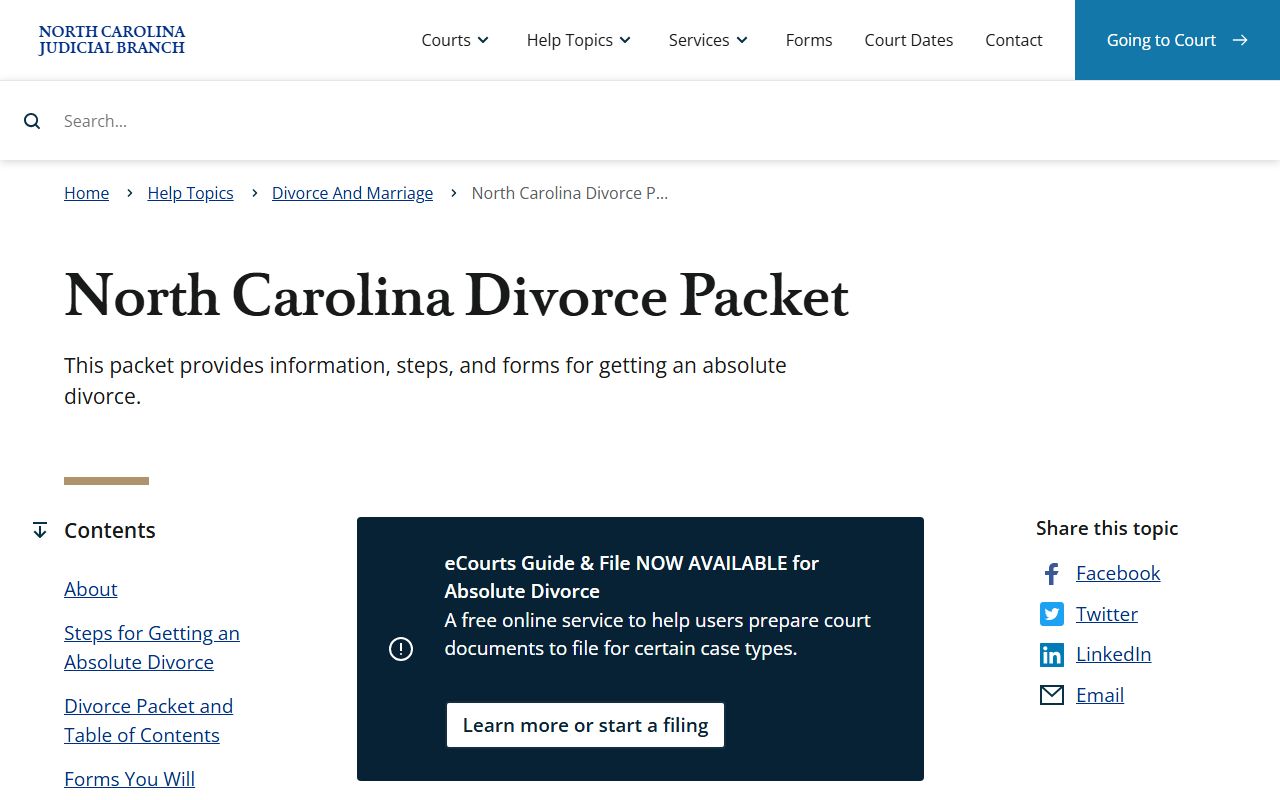
Domestic filings show why District Court case access is broader than criminal and traffic schedules alone.
Moore County Trial Court Offices
The useful local table is not a numbered-court roster. Moore County's trial court access points are divisions and offices inside the unified state system. The same courthouse is the local hub for Superior Court, District Court, the Clerk, magistrates, family court administration, jury service, court payments, and public terminals.
| Court or Office | Role / Jurisdiction | Address / Phone |
|---|---|---|
| Moore County Superior Court | Felonies, civil cases of $25,000 or more, appeals from District Court, and major trial matters. | Moore County Courthouse, 102 Monroe St, Carthage, NC 28327; judges (910) 722-5016. |
| Moore County District Court | Misdemeanors, infractions, traffic, domestic, juvenile, civil cases below the Superior Court threshold, and small-claims appeals. | Moore County Courthouse; judges (910) 722-5012. |
| Clerk of Superior Court | Filings, records, public terminals, copies, estates, judgments, and case-file custody. | Moore County Courthouse; (910) 722-5000. |
| Magistrates | Initial appearances, certain warrants and criminal process, small claims functions, and magistrate marriages. | Moore County Courthouse; (910) 722-5019. |
| Family Court Administration | Family-law case management and file-number inquiries. | Moore County Courthouse; (910) 722-5015 or (910) 722-5067. |
| District Attorney District 29 | State criminal prosecution for Moore and Hoke Counties. | 103 W. Saunders Street, PO Box 429, Carthage, NC 28327; (910) 722-5010. |
Superior Court vs District Court
The main local distinction is between Superior Court and District Court. Magistrates are judicial officers within District Court rather than a separate lower court. Municipal police agencies may create incident reports, but there are no municipal trial courts in North Carolina's state court system. A traffic citation from a town, for example, still routes into the District Court system rather than a city court docket.
| Superior Court | District Court | Magistrates | |
|---|---|---|---|
| Civil role | Civil cases involving $25,000 or more. | Civil cases below the Superior Court threshold and domestic matters. | Small claims functions and certain preliminary matters. |
| Criminal role | Felony trial matters and major criminal proceedings. | Misdemeanors, infractions, traffic, juvenile, and preliminary criminal stages. | Initial appearances, warrants, and certain criminal process. |
| Family role | Limited unless a case type routes there by law. | Divorce, custody, support, alimony, domestic violence, and juvenile matters. | Marriage ceremonies and limited related functions. |
| Records access | Portal, clerk terminal, and Clerk of Superior Court file access. | Portal, clerk terminal, and Clerk of Superior Court file access. | Case records flow through the court and clerk system. |
Note: Moore County does not have separate county, municipal, justice, or JP trial courts in the North Carolina system.
Moore County Trial Court Case Flow
Criminal cases may begin with a citation, warrant, arrest, magistrate action, or other criminal process. Misdemeanors and infractions usually proceed in District Court. Felonies may begin with preliminary District Court steps and then move into Superior Court for indictment, plea, trial, sentencing, or other major proceedings. The District Attorney for Prosecutorial District 29 handles state prosecution for Moore and Hoke Counties.
Criminal flow: Charge or process › magistrate or first appearance › District Court stage › Superior Court felony stage when applicable › plea or trial › judgment and sentence › appeal.
Civil and family flow: Complaint or petition filed › summons and service › answer or response › motions, mediation, or case management › hearing or trial › order or judgment › appeal when allowed.
State cases are separate from federal jurisdiction. The U.S. Attorney's Middle District information explains the federal district that covers federal prosecutions in central North Carolina.
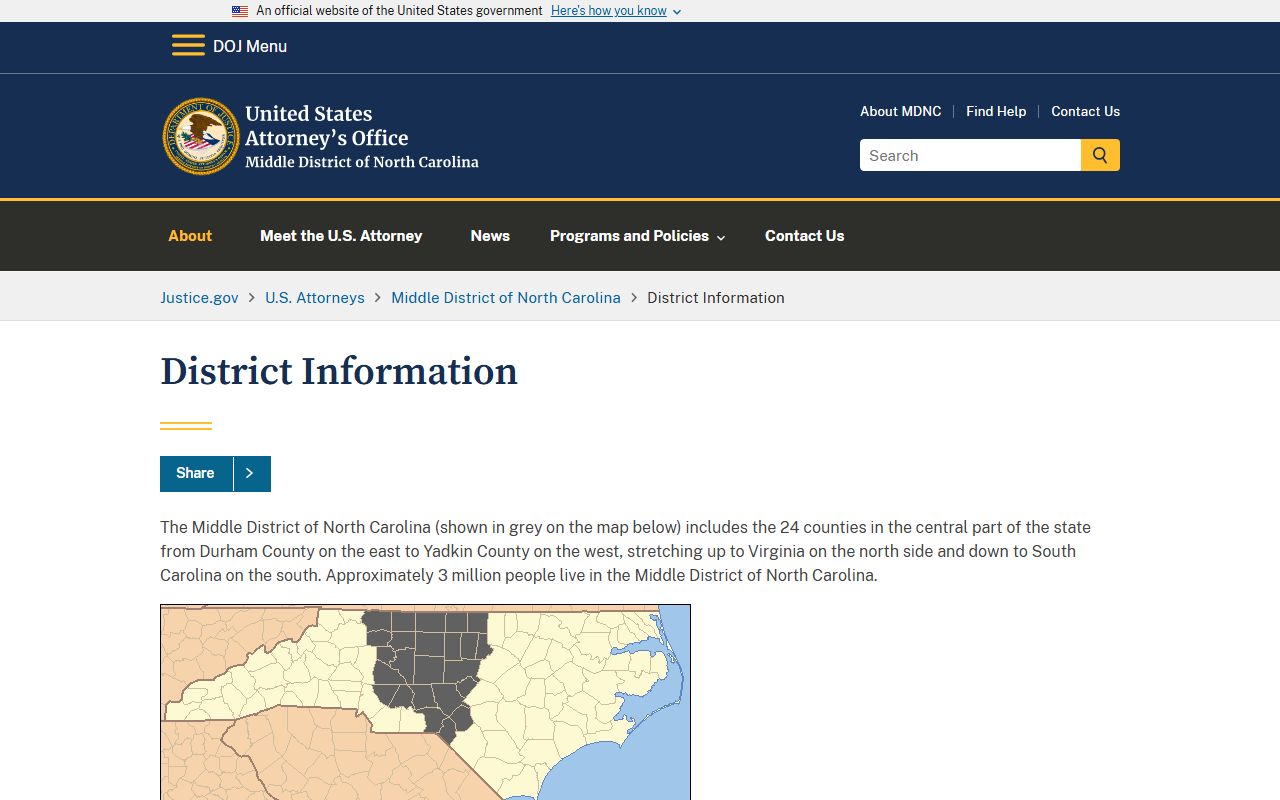
Federal prosecution is not a Moore County District Attorney matter, even when the underlying event occurred in or near the county.
Moore County Civil Family Criminal Divisions
Superior Court and District Court divide work by subject matter and legal threshold. Superior Court hears felonies, civil cases of $25,000 or more, and appeals from District Court. District Court handles misdemeanors, infractions, most traffic cases, domestic cases, juvenile matters, and civil cases under the Superior Court threshold. Estate and probate administration is handled by the Clerk of Superior Court acting in the probate role.
Family Court Administration is one of the clearest local support channels. It operates Monday through Friday, 8:00 a.m. to 5:00 p.m., and gives phone numbers (910) 722-5015 and (910) 722-5067. Parties are instructed to have the file number from the upper right corner of court papers ready. The local example format is 00-CVD-0123, which helps users recognize a civil district case number.
- Magistrate
- A judicial officer who handles initial appearances, warrants, small claims functions, and marriages.
- Disposition
- The final result of a charge, claim, or case event.
- Special proceeding
- A clerk or court matter such as an estate, guardianship, partition, or similar proceeding.
- Appeal
- A request for review by a higher court or division when law allows it.
Judicial District 29
Moore County is in Judicial District 29 with Hoke County for District Court and Prosecutorial District 29 for the District Attorney. The official District Attorney page identifies Mike Hardin as District Attorney and lists a Carthage office address near the courthouse. The same regional structure matters for appointed counsel questions, since NC Indigent Defense Services identifies Moore County as Defender District 19D and directs people to contact the Clerk of Superior Court to find out whether a person has a lawyer.
A 2025 Judicial Branch news item reported that Governor Josh Stein appointed Tron Ross to serve as District Court Judge in Judicial District 29 for Hoke and Moore counties. Judicial assignments can change, so case-specific judge, courtroom, and hearing details should be checked through the portal, local schedules, a notice, or the clerk.
Federal Court Coverage Near Moore County
Most Moore County federal matters are outside the state trial court system and are generally served by the U.S. District Court for the Middle District of North Carolina. The counties-served page lists Moore County, with an exception for the portion encompassing Fort Liberty Military Reservation and Camp Mackall. Federal district court records are searched through PACER or federal court systems, not through NC eCourts.
Bankruptcy is also separate. Moore County bankruptcy cases go through the U.S. Bankruptcy Court for the Middle District of North Carolina, not through the Clerk of Superior Court's estate process. A state probate file and a federal bankruptcy file can both involve assets, debts, and court orders, but they are different records in different court systems.
The official Middle District counties-served page identifies the federal district coverage for Moore County.
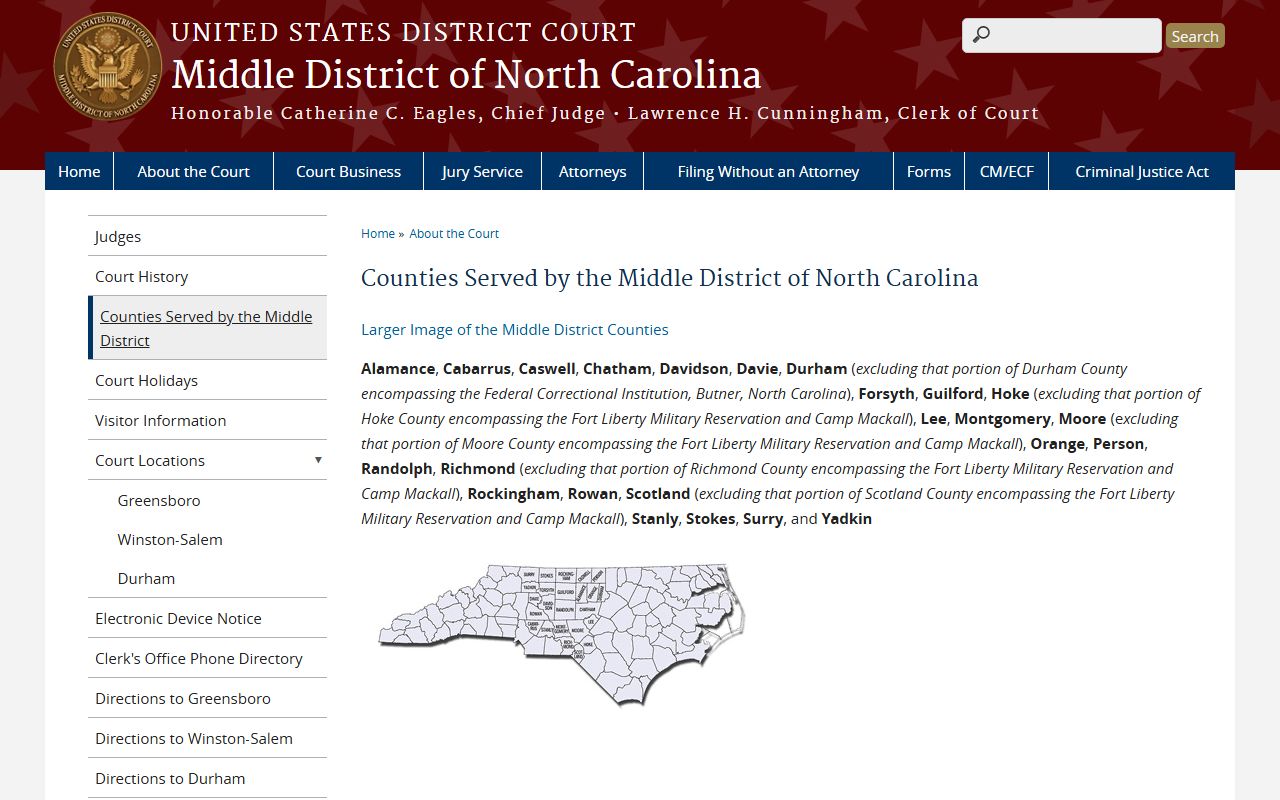
That distinction helps prevent a federal case search from being routed to the Moore County Clerk of Superior Court by mistake.
Moore County Magistrates and Lower Functions
Magistrates are part of the District Court system. In Moore County, the contact directory lists Magistrates at (910) 722-5019. Research notes tie magistrates to initial appearances, warrants and certain criminal process, small claims functions, and marriages. For magistrate marriage ceremonies, the Register of Deeds material says to call (910) 722-5019 the morning of the desired ceremony and notes that marriages are not typically performed on Tuesdays.
Municipal police departments still matter for incident reports. The Sheriff's Services page says county incidents route to the Sheriff, while incidents in municipalities such as Carthage, Southern Pines, or Aberdeen should be filed with the relevant municipal police agency. That report routing does not create a separate municipal court record.