
Moore County Criminal Case Files
Moore County criminal court records are case files maintained by the Clerk of Superior Court for criminal matters in the North Carolina trial courts. The file begins when a criminal charge is filed or transferred into court. It can then grow to include court dates, bond conditions, attorney appearances, motions, orders, pleas, verdicts, dispositions, financial obligations, and sentence details. The custody side of an arrest may appear in jail records, but the court file is the official place to read the case result.
North Carolina uses a unified state court system. In Moore County, misdemeanors, infractions, and many first appearances are District Court matters, while felony cases are handled in Superior Court after indictment or other transfer. Magistrates are part of the District Court system and may be involved in initial criminal process, warrants, and first appearances. Criminal court records from Carthage, Southern Pines, Pinehurst, Aberdeen, Vass, and other local communities still route through the county courthouse because North Carolina has no separate municipal trial courts.
The full criminal case file should not be confused with the first charge listing after an arrest. The charge listing explains the accusation. The criminal court file later shows what the court did with that accusation. For the arrest-to-charge pathway, see Moore County arrest records and court charges.
The official District Attorney District 29 page identifies the local prosecutorial district for Moore and Hoke Counties.

That prosecutor role matters because criminal case files often show actions taken by the State, not just filings from law enforcement.
Search Moore County Criminal Records
The primary online path is the NC eCourts Portal. Moore County joined eCourts in Track 6, and the portal provides Smart Search for case information, Search Hearings for court dates, Make Payments for some criminal and infraction obligations, and judgment search tools. The portal requires JavaScript and cookies. Anonymous, registered, and elevated users may face a CAPTCHA every ten minutes, and some documents may be limited by role or confidentiality.
- Open the NC eCourts Portal and choose Smart Search for criminal case information.
- Search by defendant name or case number. Official portal training supports wildcard searching when enough characters are entered.
- Use Moore County as the county or location filter when the portal offers that choice.
- Open the case summary and review charges, hearings, docket activity, disposition, and financial entries.
- For certified copies, older paper files, or unclear records, contact the Moore County Clerk of Superior Court.
A courthouse public terminal is still an important fallback. North Carolina court guidance says criminal case information can be searched on public self-service terminals in clerk offices by defendant name, case number, victim name, or witness name. The physical paper file is reviewed in the county where the case is located, so Moore County files are handled through the Moore County courthouse.
The NC Indigent Defense Services Moore County page explains appointed-counsel routing for criminal defendants.
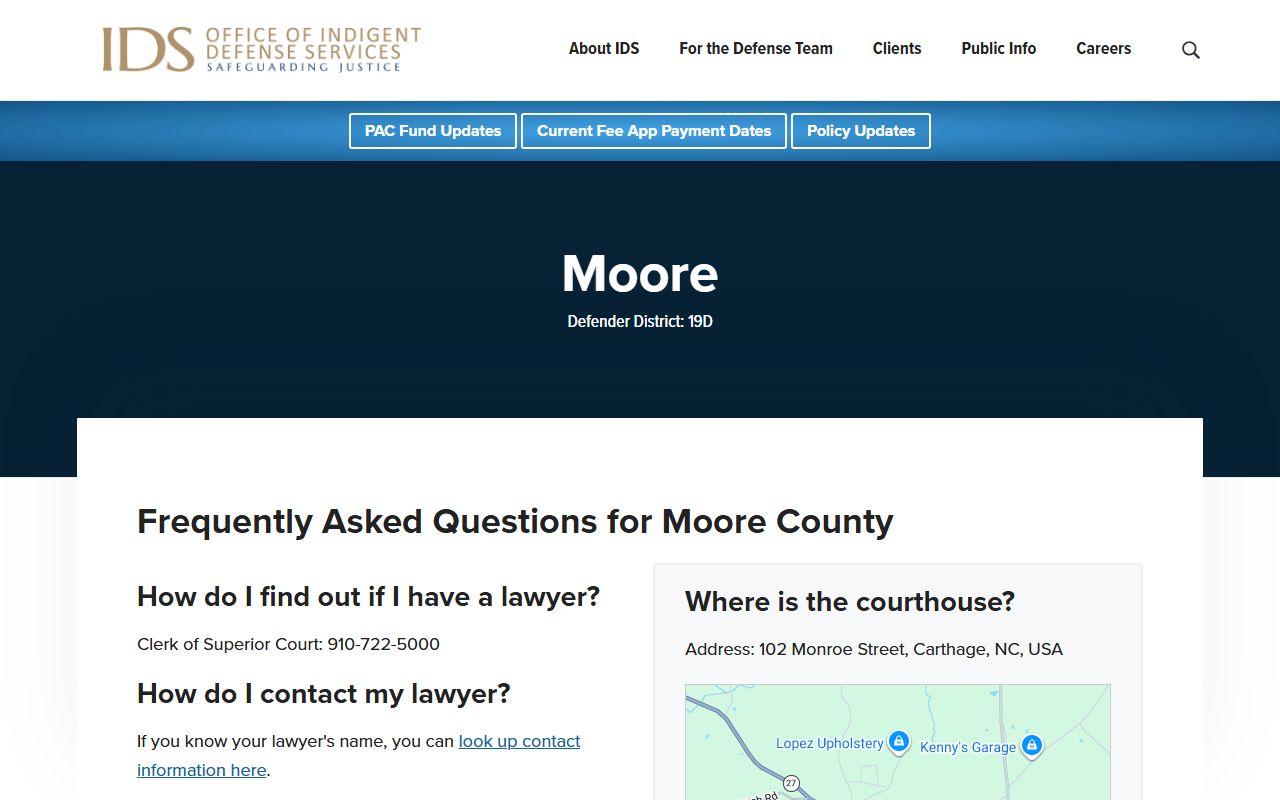
Attorney and appointment information can help explain docket entries that list counsel, waivers, substitutions, or future court dates.
Moore County Criminal Case Stages
A Moore County criminal record is easiest to read as a timeline. The accusation starts the file, but the court record becomes more useful as it tracks each event in order. A case may be continued, dismissed, reduced, transferred, resolved by plea, tried before a judge or jury, or sent to sentencing. Each action should appear as a docket entry, order, judgment, or disposition line when it is public and recorded.
Case flow: Charges Filed › Arraignment › Pretrial and Motions › Plea or Trial › Disposition › Sentencing
| Stage | What the Criminal Record May Show |
|---|---|
| Charges filed | Offense name, count, statute reference, process type, and the court division where the case begins. |
| First appearance or arraignment | Initial court date, bond or release conditions, attorney status, and plea-related entries when applicable. |
| Pretrial and motions | Continuances, discovery issues, motions, orders, scheduling entries, and attorney appearances. |
| Plea or trial | Plea, verdict, dismissal, acquittal, or other result for each charge or count. |
| Sentencing | Judgment, sentence terms, probation, restitution, fines, costs, and payment obligations. |
One case can have more than one charge. One charge may be dismissed while another ends in a conviction. That is why the case-level disposition and the charge-level disposition both matter.
Moore County Criminal Record Fields
Typical Moore County criminal court records include identifiers, parties, filings, hearings, and outcomes. The eCourts public view may show a summary, while the clerk terminal or paper file can be needed for documents that are not visible online. Access also depends on whether a record is sealed, expunged, juvenile, or restricted by personal-identifier rules.
| Field | What It Shows |
|---|---|
| Case number | The court file number assigned to the criminal or infraction matter. |
| Court division | District Court or Superior Court, depending on the charge and case stage. |
| Defendant and State | The accused person and the State of North Carolina as prosecuting party. |
| Charges | Offense name, statute or cause, count, and related criminal-process information when public. |
| Docket entries | Hearings, continuances, filings, motions, orders, notices, and other court activity. |
| Disposition | Pending, dismissed, guilty, not guilty, judgment entered, closed, appealed, or other status. |
| Financial data | Fines, court costs, restitution, attorney fees, and payments when assessed by the court. |
| Sentence | Probation, custody, restitution, or other terms imposed after conviction. |
The Judicial Branch criminal background check help topic describes the certified single-county search process.
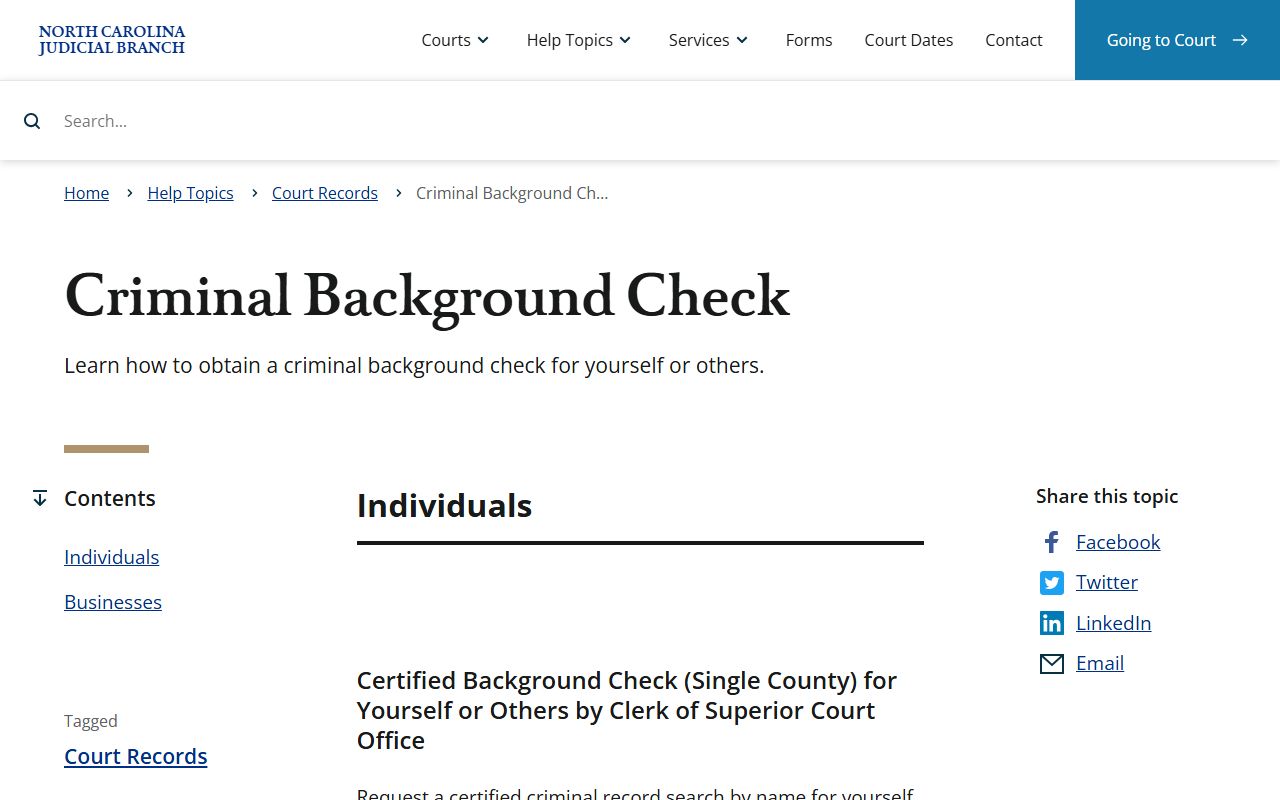
That certified search is a court-record product from the Clerk of Superior Court and is limited to the single county requested.
Moore County Charges and Convictions
A charge is an accusation. A conviction is a court outcome based on a guilty plea, verdict, or other judgment of guilt. Moore County criminal court records may show charges that were amended, reduced, dismissed, or resolved with different outcomes. Reading only the first charge line can lead to a wrong conclusion about the case result.
| Point | Charge | Conviction |
|---|---|---|
| Meaning | An offense alleged by the State or law enforcement process. | A final finding of guilt by plea, verdict, or judgment. |
| Timing | Appears early in the criminal case. | Appears after plea, trial, or final disposition. |
| Record risk | May remain visible even if later dismissed unless sealed or expunged. | May affect sentence, costs, probation, and state driver or correction records. |
For people checking employment, housing, licensing, or other regulated background matters, a casual case lookup is not the same as an FCRA-compliant consumer report.
Public Access to Moore Criminal Records
North Carolina law gives the Clerk of Superior Court a specific record-keeping role. General public-records law is relevant, but court case files are not handled like ordinary county administrative records. The practical path is portal search, courthouse terminal review, clerk copy request, and certified copy request when a formal record is needed.
Key access rules:
G.S. 7A-109 requires clerks to keep court records, files, dockets, and indexes open during office hours unless the law bars access.
G.S. 132-6 addresses inspection and copying of public records at reasonable times, subject to legal limits.
G.S. 132-6.2 governs copy media and public-record copy fees.
The North Carolina inspection and copies statute is relevant when public access questions arise.
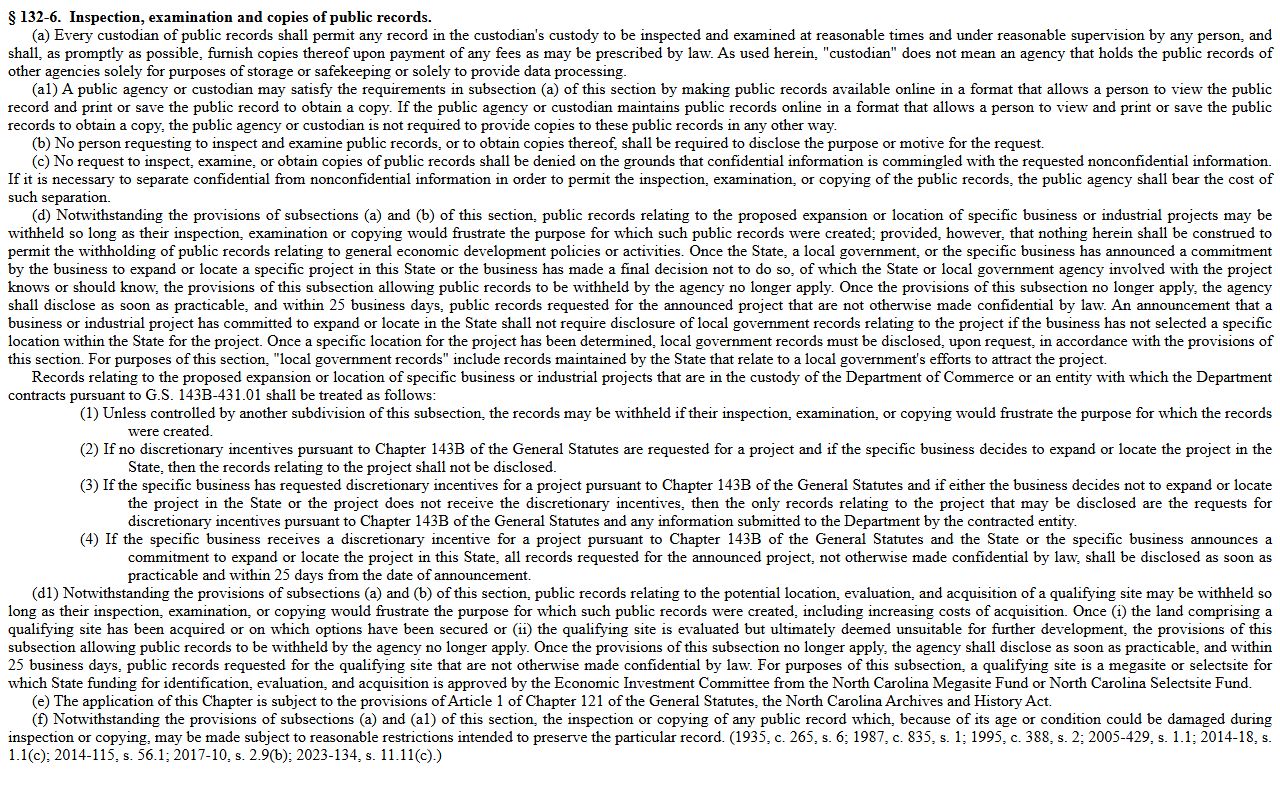
For criminal case files, the clerk remains the local office that certifies Moore County court documents.
Sealed and Expunged Criminal Records
Not every Moore County criminal record is open to the public. Juvenile matters, adoption-related files, mental-health proceedings, sealed cases, expunged records, and records with protected identifiers may be restricted or redacted. A missing case in the public portal does not prove that no case ever existed.
| Point | Sealed | Expunged |
|---|---|---|
| Public view | Closed from ordinary public access by law or court order. | Removed from normal public record access under an expunction order. |
| Authority | Depends on statute, court order, or confidentiality rule. | Depends on a North Carolina expunction statute and court approval. |
| Search result | May not appear in portal or clerk public terminal results. | Should not be treated as an ordinary public criminal case record. |
The North Carolina expunction statute collection identifies multiple paths for different record types.
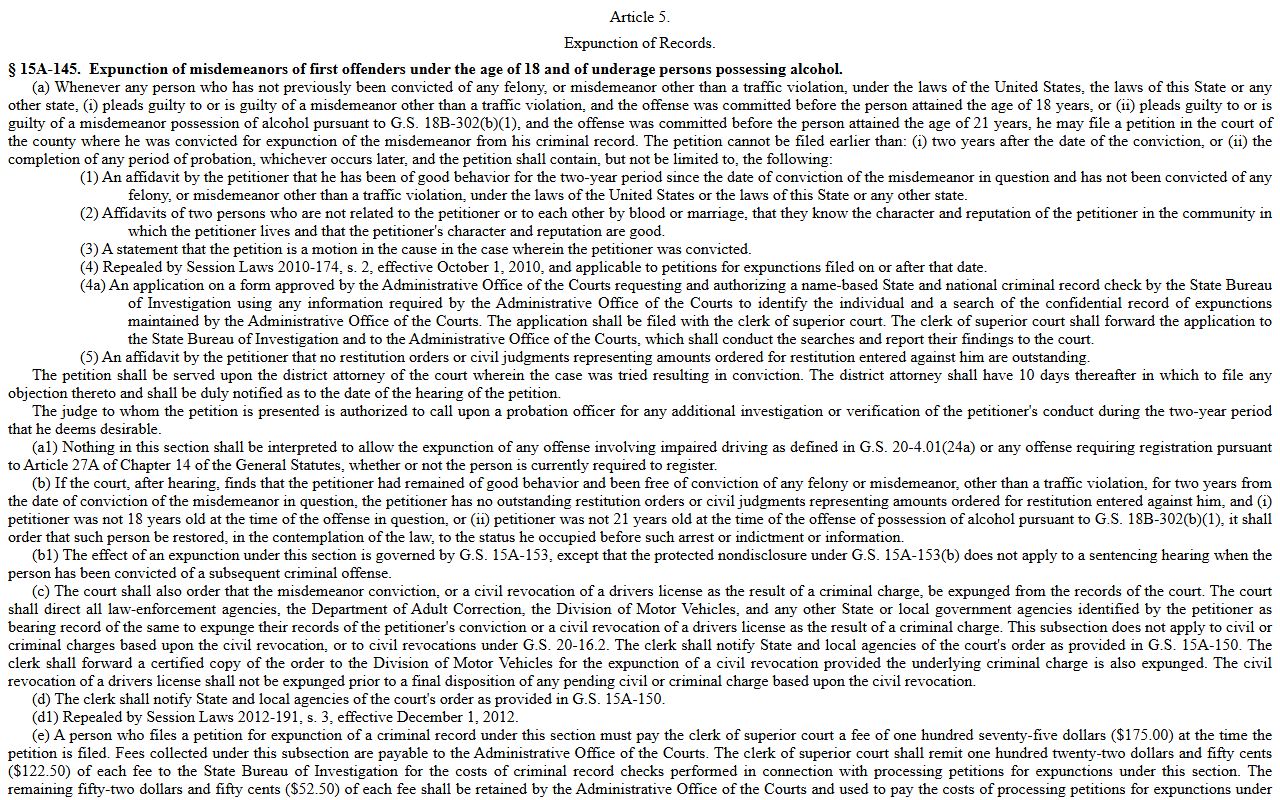
Eligibility depends on the charge, disposition, prior record, waiting period, and the exact statute used.
Note: Expunction is case-specific and should be checked against the statute and the Moore County court file.
Moore County Background Checks
A certified criminal background check for one county is requested through the Clerk of Superior Court using the official AOC-CR-314 process described by the Judicial Branch. The research file lists a $25 fee for that single-county certified search. It is not a statewide criminal history search, and it does not replace a regulated consumer report for employment, credit, tenant screening, insurance, or other FCRA-covered use.
The request should identify the subject clearly. Useful information includes name, aliases, date of birth when requested by the form, county, certification request, requester contact details, and payment. For statewide prison, probation, or parole status, the NC Department of Adult Correction offender search is separate from Moore County criminal court records. For current local custody, the detention roster is a custody source, not the court disposition source.
Important: Public case lookup is not an FCRA consumer report and should not be used for regulated screening decisions.
Restricted Moore County Criminal Records
Adult criminal case files are more open than juvenile or sealed matters, but limits still apply. Public entries can omit protected addresses, Social Security numbers, account numbers, minor names, driver-license data, and other identifiers. Some documents may be visible only at a clerk terminal or only to parties, attorneys, or approved users. Search warrants may also be sealed or unavailable while an investigation is active.
When a public portal result conflicts with a paper file, the safest next step is to contact the Moore County Clerk of Superior Court at the courthouse. The clerk can explain copy access, certification, and local file review. The clerk cannot give legal advice, but the office is the record custodian for Moore County criminal court files.